Showing posts with label comedy jokes. Show all posts

Monday, May 14, 2018

Movies You May Have Missed - Clockwatchers (1997)

I don't know why it took me more than 20 years to see Jill Sprecher's Clockwatchers in full, but life is full of mysteries and this is only one of many. Sprecher, working from a spare and quietly lacerating screenplay co-written with her sister Karen, created the temporary-employee office-noir two years before the much more lauded white-collar satire Office Space. Her stylish study on the de-humanization of the American workforce deserves more accolades, particularly because it stars a stellar cast of four women (Toni Collette, Parker Posey, Lisa Kudrow, Alanna Ubach) as office temps in corporate purgatory. Written and directed and starring women about womens' work experiences within the male-dominated capitalist system—I cannot for the life of me fathom why this cult film isn't more celebrated. What could possibly factor into that I wonder.

And now:


Shy, unassuming Iris (Collette) is a new temp within the insular putty-colored world of Global Credit. It's an environment ruled by the clock, to the point that Iris is completely ignored by the receptionist until 9 A.M. rolls around, wherein she's instructed to sit on a chair to await further instructions. Two hours of muzak-laden negligence later, she's reprimanded by the office scold (née manager) Barbara (Debra Jo Rupp) for following directions.

Anyone who's ever temped before will recognize this barely exaggerated scenario as base truth within the world of middle-management. And guess who's temped for years on end in countless office environments? That's right, me. So consider me your expert on the subject. Aren't you lucky I'm here to vouch for what appears surreal and heightened but is in actuality true in scope?


In the sterile confines of her new job in a town with no name, muzak is pumped overhead throughout the day to "boost productivity," barely concealing the buzz of fluorescent lighting and quiet desperation masquerading under polite social norms. Margaret (Posey, sharp and brilliant), a temp who's been around long enough to know all the slacker tricks to get through an eight-hour day, takes Iris on the dreaded "office tour." During which she meets all the office types who would also be parodied by Mike Judge in Office Space: the snitching rule-follower, the grinning golden boy, the patriarchal senior executive, the bossy fuss-budget, the vindictive phony, and the anal-retentive supply clerk (Stanley DeSantis as "Art," close cousin to Office Space's cult figure Milton, played by Stephen Root with similar mumbling weirdness). Is it possible Judge never saw Clockwatchers before making Office Space?–maaaaybe... U.S. office culture trends toward the universal. Still, Art and Milton are practically twins in schlub-brotherhood.


Margaret, who despite her grasping desire to be hired permanently, is styled slightly "off" for office culture, in keeping with her rebellious spirit: skirts a bit too short, shoes too casual and comfy. Decked in warm shades of red, her patterns and florals among the navy-blue power suits read like warning flags, signals about how not to get ahead in this stifling mono-culture.


Margaret recognizes the futility of identifying with your job when you're basically a file clerk. Still, she has a terrible work ethic and sucks up to power (gloriously) to get what she wants. She's a scammer par excellence and reminds me of many of the people I was attracted to in my 20s, in and outside of work.


Iris, among her new office pals, begins to bloom within the radiance of Margaret's sass. Soon-to-be-married perfectionist Jane (Ubach, with her huge eyes, a living anime in Chanel suits) and would-be man killer/actress wannabe Paula (Kudrow, flipping hair and attitude way back in '97) are exactly the kind of friends you make while temping—you have nothing in common but the dead-end job, but sometimes for the moment that's enough.


When small personal items go missing throughout the office, things take a dark, existentialist turn. Not that the entire enterprise wasn't dark or existentialist to begin with, but now the four temps, always on the peripheral of job status with their lack of benefits, paid days off, or ability to advance unless offered the coveted permanent position, become the number-one suspects.

Margaret suspects the new permanent hire, prematurely shriveled Cleo (Helen FitzGerald), lurking about, copying Iris' newly acquired beaded and floral styles, to be the thief. Margaret's fury at being passed over for permanent status, her belittling family and ongoing petty scams, along with the office's new security cameras, lack of privacy and suspicion of anyone outside the credit "family" begin to erode the tenuous social glue that holds the little group together.


A coup-in-the-making is plotted. The male executives continue to yelp orders or smile condescendingly, never learning the names of the young women who do their shit work for low pay. Although I always appreciated that temp work existed, allowing me to attend school and live in San Francisco among my fellow freaks, I'm here to tell you that this film is eerily accurate. I direct no blame to my former co-workers and managers, the majority of whom were working moms who needed a decent income to live in the Bay Area and raise their children. But office culture still frowns on individuality and free-thinking. This is a purgatory of stultifying boredom for an enforced eight-hour-day (most every job I temped could be done in less than three, but everyone was in denial).


A strident Margaret wants to burn the whole thing to the ground and start over. Who will join in? The film, a wise character-study as well as surreal satire, doesn't make that much of a suspenseful plot point on workers' rights. We can already see the group dynamic disintegrate in small, painful and emotional ways.


When you need a myriad of emotions from your lead actress, hire Toni Collette. We have to wait a while for Iris to take her stand, but it's worth it. A rare film about women's work and women's relationships and how they affect one another. Add it to your cult-film roster.
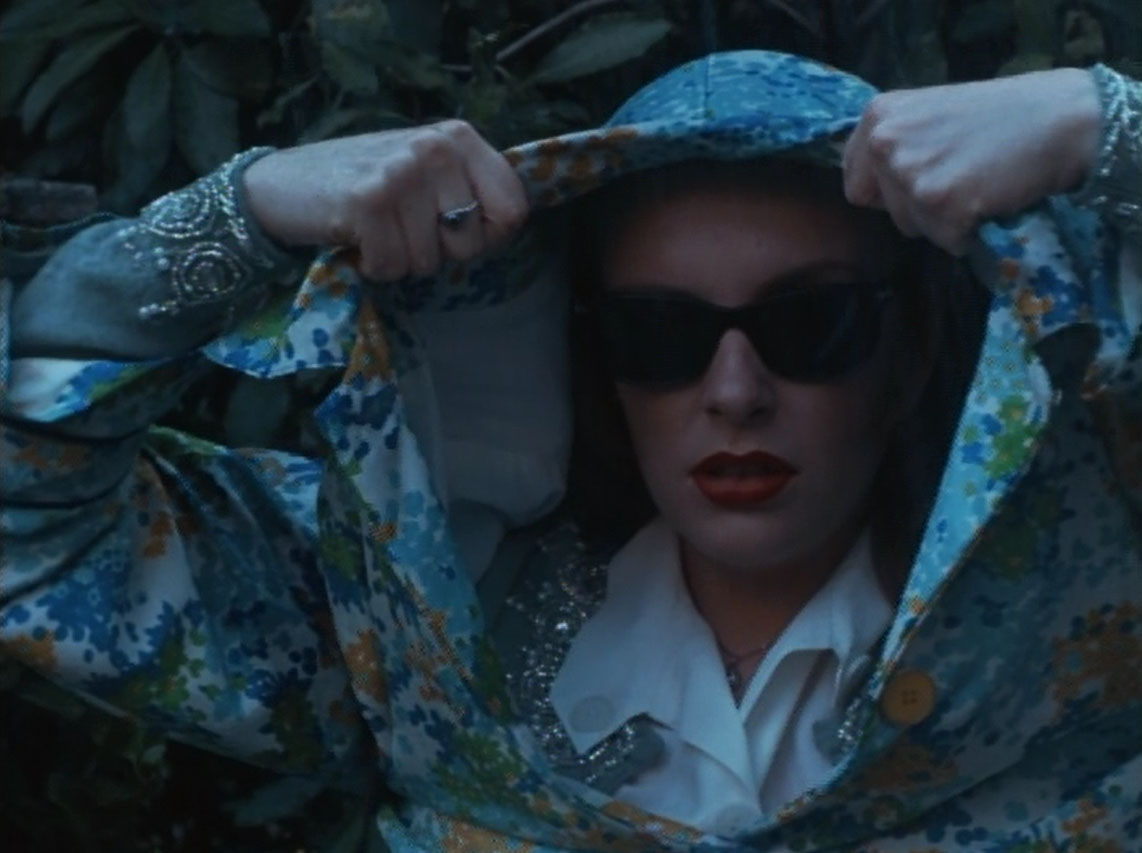


And now, to help with your productivity, I gathered some of the fine Clockwatchers office-muzak soundtrack for you to file your papers by. May you get permanent status and a letter of recommendation, always.

"Azure Sands" - Les Baxter


"Jalaba" - Les Baxter


"Magenta Mountain" - Les Baxter


"Theme from A Man Called Dagger" - Steve Allen


"Raindrops Keep Falling On My Head" - Hugo Winterhalter & His Orchestra


And in keeping with any worthwhile soul-crushing existential office crisis, plenty of offerings from the Paris Musette.


Friday, December 22, 2017

The heightened cartoon-brilliant art direction of "Dick" (1999)

Has anyone checked in with Dick lately? Directed by Andrew Fleming from a script by Fleming and Sheryl Longin, starring young Michelle Williams and even younger Kirsten Dunst as endearingly dumb best friends, Dick came and went in 1999.

Mashing together the teen comedy with political satire is a challenging task and Dick struggles with its premise, especially attempting to answer the question of who is the audience for this movie: Teens living on the cusp of the 21st century, who have little to no knowledge of the Watergate scandal and its myriad of corrupt players? Adults who lived through the 1970s, watching as intrepid journalists and the legal branch took down paranoid would-be despot Richard Milhouse Nixon? No one was sure how to market this one for maximum audience.

One aspect of this film is crystal clear in its premise and its execution—the art direction by Lucinda Zak, who took all that was hideous, deformed, brilliantly muddy and wrong-headed about 1970s style and ran straight down the field for touchdown after touchdown with it. If you're looking for a feast of 70s oddities for the eyes, this is your movie; sit back and enjoy.

A slew of amazing comedy talent co-starred as historical figures of the Nixon White House era, including Will Ferrell as Bob Woodward, Bruce McCulloch as Carl Bernstein, Dave Foley as Bob Haldeman, Ana Gasteyer as Rose Mary Woods, Harry Shearer as G. Gordon Liddy, which is a comedy of riches, but then it's all topped off by Dan Hedaya just throwing himself into the role of Dick Nixon, plus the great Teri Garr as a Watergate-Hotel dwelling single mom who, like most of the adults in this would-be teen-comedy/political satire, has no idea what's going on under her very nose.

And now, Dick.

Title features a manual typewriter with psychedelic bubble font

Our protagonists, bubbly Betsy Jobs (Dunst) and her romantic best friend Arlene Lorenzo (Williams) are two high-school sophomores who can't wait to win a date with their idol Bobby Sherman. But when they sneak outside of Arlene's Watergate apartment's bedroom to mail in their contest entry, stumbling upon a late-night break-in, fate has other plans in store for them.


The detail in every upper middle-class set of this film is astonishing. Note Arlene's trendy TV and bedroom phone (both luxuries in the inflated 70s) alongside her crafty Bobby Sherman shrine.


According to the DVD commentary (yes, as a dedicated chronicler of obscure film history, I listened to that) a warehouse full of period-era polyester fabrics was discovered pre-production and so Dunst and Williams were treated to a wardrobe of custom-made clothes made from unbreathable synthetic fabrics—great way to get into character—the 70s were colorful but uncomfortable for most of us.

Some major polyester going on here

This is a cartoon version of the Watergate scandal, but perhaps that's what's needed after a dark political corruption storm of this magnitude. Wait, was I just describing the early 70s or today? Either way, over time, the sociopaths at the center of corruption tend to look more absurd (but just as creepy) with hindsight. And also, look at the 70s—this art direction is only a slight exaggeration of certain 70s concepts, and when I say slight, I mean the width of a polyester thread.


Betsy gets the "cool" history teacher and it shows in her presentation.


While poor Arlene gets the "uptight" teacher. This was the extreme cultural divide that we found ourselves in after the social upheaval of the 60s.


Betsy and Arlene are solidly upper middle-class and have plenty of leisure time to enjoy the latest in 70s fads and fashions. The last of the baby boomers, allowance-dollars in hand, had plenty of recreational and consumer activities to partake in. I don't know who on the film crew painted and lit this roller rink, but I want to shake your hand.


A typical (hyper-real) hip girl's room of the era. Canopy bed, lots of orange, textiles, pastels, brights, patterns, flowers and a collie lamp to add a touch of whimsy.


The heady days of trying to make sense of a world gone mad through the prism of girlhood friendship.


Featuring David Cassidy fandom. RIP.


Ana Gasteyer as Nixon's extremely dedicated secretary Rose Mary Woods.


Dick sets in motion a series of events that filter the Watergate scandal through the actions of two bumbling sub-intelligent girls. It's purposefully silly as hell, but the girls, as performed by Dunst and Williams, are endearing. And their dum-dum legacy is a sort of prequel to another cult film Romy and Michele's High School Reunion, which remains the pinnacle of dumb friendship movies as far as I'm concerned.

Nixon recorded everything he said—leading to the downfall of a paranoid would-be zealot


More polyester in our nation's capitol.


Ryan Reynolds, in one of many effective and very funny small roles, and a muscle car.


And here's a typical teen-boy room of the era. Trophies, plastic skulls, groovy love poster all framed in brown plaid (not shown: beer bong).


According to the DVD commentary, once Will Ferrell was on board playing straight-laced Bob Woodward to Bruce McCulloch's preening, narcissist Carl Bernstein, a flock of funny people joined the fray.

Best use of Yes's "I've Seen All Good People" in a scene of journalistic triumph

Comedy goddess Teri Garr, long may she reign.


This Watergate Hotel room cannot get any more 70s than this


Also on hand is Devon Gummersall as Betsy's stoner brother Larry, who might be the most insightful person in this satirical world, albeit while being very, very high.

Do you like brown? Then you'll love the 70s

Dan Heydaya firing all his guns as, at the time of filming, one of our freakiest most corrupt Presidents.


I would never make any effort to rehabilitate Nixon's image. He was a criminal, a freak, and deeply flawed on many levels. But the orange person currently residing in the White House makes Nixon look a lot more like an actual human. Sad.


Just here for the poncho in the foreground. My aunt made me one of these for Christmas one year and I was kicking it in second grade in my swinging poncho—thanks Auntie Joan.


A tight shot of a period department store demonstrates what creative art direction and a decent budget can accomplish.


For the girls, the Watergate conspiracy comes to its ultimate conclusion. At the mall. Which is very 70s.


So long, Dick.


In conclusion, I would like to see Kirsten Dunst and Ryan Reynolds do more comedy—they have the chops and they're both so effortlessly charismatic onscreen. I would also like to update Dick for the Trump era and I would call it Shit. But that's just a working title. And the story would begin in the 80s, because imagine the art direction!

Monday, November 07, 2016

Movies You May Have Missed - "Boy" directed by Taika Waititi (2010)

Set in 1984 on the coast of New Zealand, Taika Waititi's Boy is a semi-autobiographical story of childhood that touches on the emotional aches, miseries, confusion, awkwardness and best of all, humor, that children depend on to survive while under duress. How Waititi managed to keep an absurd light touch throughout what could have been a dark tale of loss and neglect is just one of his special talents.

You might have seen Waititi as the foppish vampire Viago in his satire What We Do in the Shadows (co-directed with Jermaine Clement and released in 2015 after a successful Kickstarter campaign). If so, you know he's a proponent of character-driven storytelling. Here, his remarkable cast of mostly children are all distinct people with their own life philosophies, needs and desires. They live in poverty, surrounded by natural beauty, and rely on each other. Yet they let each other down in so many ways, because they're children and children make many mistakes as they grow, as do their guardians and would-be guardians.

Children suffer and endure and children are hilarious. At least these children are. If you have exquisitely torturous but beautiful memories of Francois Truffaut's The 400 Blows and Lasse Hallström's My Life as a Dog, you're going to be in a good place watching Boy.

Welcome to Waihau Bay, New Zealand, where 11-year-old Alamein (a remarkably expressive James Rolleston, cast from a pool of extras a couple days before production) is known as "Boy" by his Maori family and friends. He lives with his grandmother Nan (Mavis Paenga), little brother Rocky (Te Aho Aho Eketone-Whitu) and multiple tiny cousins, headed up by his age-equivalent cousin Kelly (an eye-rolling observer of male behavior and my personal style icon, Cherilee Martin).

"Welcome to my interesting world!" announces Boy during a school report—indeed

Boy has a small group of friends but he's a fantasist in a population of realists, and he's not going to win any popularity contests, even at his tiny country school. Mostly he dreams about Michael Jackson and his killer dance moves, the pretty girl in his class, Chardonnay (RickyLee Waipuka-Russel), who barely acknowledges him, and his namesake and father (Waititi), who's serving jail time but in Boy's mind, is an incredible dancer, combat veteran and all-around action hero. Rolleston has that remarkable star quality of behaving as if the camera isn't there, yet he innately and honestly knows how to play to the camera.


Boy's incomparable cousin Kelly makes the most of domestic goddess role-playing while barely uttering a word.


It's beautiful in New Zealand and if the kids are having a tough time, no one's complaining. There's a social network in place and no one has money to lord over anyone else—just various Michael Jackson accoutrements and maybe some height to lord over the smaller kids. Maybe some underhanded drug dealing. Boy's rich fantasies of a hero father help make up for the loss of his mother, whose demise is deftly and tragically shown through slivers of flashbacks, much like dimly remembered childhood memories.


Boy's brother Rocky is even more socially isolated, spending his time drawing, honing his super powers, which spill out of his mind and onto his crayon-colored notebook pages (the use of animation for Rocky's imaginings is in keeping with a visually attuned child), and talking to his mother's grave. 


When Grandma Nan travels for a couple of weeks to a far-away funeral service, leaving Boy in charge of the household, trouble arrives in the form of his father and two dimwitted jail cohorts—a would-be biker gang without any bikes. Or sense. Or morals.


His father's multiple failed money-making schemes and slim grasp on reality does nothing to damper Boy's rapturous worship of this dunderheaded anti-parent. Even as his father continuously disappoints everyone around him, Boy simply forms new fantasies to top the old.


Waititi's foolish Alemein rarely if ever admits to his mistakes and therefore learns little or nothing. This is actually refreshing in a movie about growing up. And how realistic in scope. Those of us disappointed by failed authority figures were bright enough to know that some adults were messed up, unable to change, and were just not going to be there for you in any capacity. The kids in this film know that too. These kids are hyper-bright but Boy's intelligence is trumped by his need for a parent. That's real too.


Alamein Sr. is not completely devoid of charm. Some mostly inappropriate gifts are passed out from the trunk of his car, including sparklers, roller skates and some fine lady's garments. The kids grasp these new items like magical totems, as kids will do. Pop culture of the 1980s inspires some memorable names among Boy's friends, including brother and sister Dallas and Dynasty, who have their own struggles as they watch Boy struggle, shaking their heads at his cluelessness.


Boy plans to join his dad's gang and only after multiple and escalating disappointments is he able to see his dad as the flawed person he is. This is a sad trajectory which leaves reverberations throughout the household and small community. Reality is a slap in the face, a reckoning, a conversation at a grave-site.

How do kids survive this harsh world?—with help from reliable people. They don't even have to be all that outwardly loving either—just there for you when you need them. Also, Michael Jackson dance moves help. Boy learns to face his reality with openness and honesty. That can hurt. Thank God cousin Kelly is walking around the homestead in that fur jacket and cocktail dress, because that helps too. At least, it helps me.

Be sure to stay for the closing credits. This film is a joy from start to finish. I love the kids so much. Their lilting speech patterns delivered in perfectly flat deadpan is my favorite music at the moment. Hail!


Trailer